
Nimisha Vinod
MSc in Food Innovation, MSc in Biotechnology
The previous article discussed the use of additives in meat processing.
This third part addresses a major concern in the modern world—the formation of carcinogenic compounds during meat cooking. These cancer-causing substances, which can develop during prolonged or high-temperature cooking, may contribute to
- gut dysbiosis
- impaired digestion
- potentially affecting the function of other body systems
and increasing the risk of cancer development.
Carcinogens in processed meat
Meat serves as a rich source of essential nutrients that the human body is unable to synthesize on its own. Cooking enhances its palatability and digestibility by denaturing proteins and softening muscle fibres.
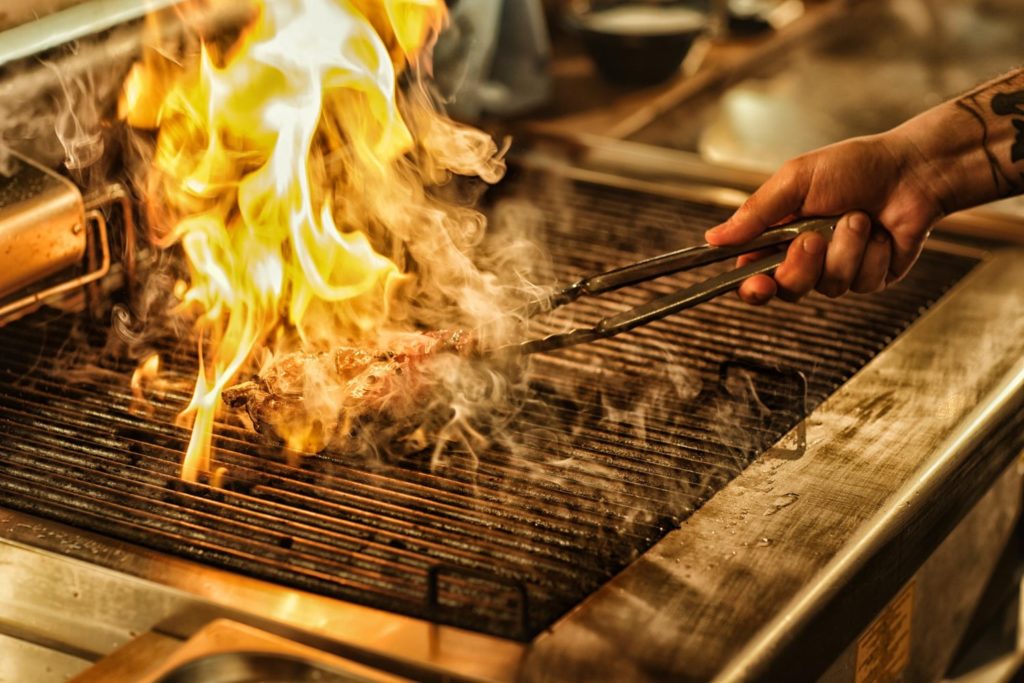
However, cooking the meat at high temperatures for a long time raises significant health concerns. The high temperature degrades the proteins more quickly and initiates the release of amines and cyclic chemical compounds like
- Heterocyclic aromatic amines (HAAs)
- Polycyclic aromatic hydrocarbons (PAHs)
The addition of nitrites to meat can potentially react with these amines at high temperature to release N-nitroso compounds (NOCs). HAAs, PAHs and NOCs have been reported to interfere with human metabolism, leading to cancers.
Heterocyclic aromatic amines (HAAs)
Heterocyclic aromatic amines (HAAs) are formed when meat is fried, grilled or smoked at 120°C and above.
They are reported as group 2B human carcinogens by The International Agency for Research on Cancer (IARC). These should be avoided from consumption and frequent intake of these compounds increases the risk of cancers.[1]
HAAs have also been reported as potent carcinogens in rodents.[2] Their cancer-causing effect was further studied in human cells like Chinese hamster ovary systems and have also been reported as cancer inducing chemicals.
HAAs are reported as group 2B human carcinogens
Several studies have reported the positive association of HAAs with colorectal and other cancers.[3]
As HAAs are cyclic complex chemical molecules, they pair with the DNA forming genetic mutations. These mutations activate the cancer genes in the cell, eventually turning the cell into a cancer cell.
Polycyclic aromatic hydrocarbons (PAHs)
PAHs are formed by the incomplete combustion of fats in meat and due to the high temperature used in cooking the meat. These chemical compounds are also an environmental pollutant from forest fires, incomplete burning of fuels, and other sources.
PAHs are categorized as 2A and 2B carcinogens to humans by IARC of the World Health Organization.
PAHs are categorized as 2A and 2B carcinogens to humans
While HAAs start forming with the increase in cooking time from 100°C to 200°C, PAHs start to form as soon as the meat is cooked. That means that the time of cooking and temperature for cooking the meat is responsible for the formation of these carcinogens.[3]
PAH compounds are formed from cooking methods like
- grilling
- drying
- roasting
- barbecuing
- smoking
of processed meat at high temperatures.[4,5]

In a PAHs release study during the roasting of pork loins in an electric oven using a roasting bag at 200°C reported the formation of 7 PAHs benzo(a)anthracene (BaA), chrysene (Chr), benzo(a)pyrene (BaP), benzo(b)fluoranthene (BbF), benzo(k)fluoranthene (BkF), dibenzo(ah)anthracene (DiBahA) and benzo(ghi)perylene (BghiP).[3]
In another experimental study for the detection of PAH formation of processed foods like smoked sausages, salami, smoked bacon, frankfurter sausage, ham, mortadella, cured poultry breast, hamburgers, the highest level was reported in smoked sausage, followed by morcilla and bacon.[6]

When the meat products are smoked, PAH release can depend on various factors like the
- fat/lipid content of the meat
- the moisture content
- Temperature
- Time
- food additives used
- fuel used
- presence of oxygen while smoking
smoking conditions[7,8]
PAH formation increases with increased smoking time and the temperature used in the process and the PAH concentration were higher in smoked pork sausages.[9]
N-nitroso compounds (NOCs)
Nitrates and nitrites are known additives that act as preservatives to increase the meat shelf life.
When meat is cooked at high temperatures, meat proteins and amino acids undergo denaturation, initiating a cascade of chemical reactions that lead to the formation of amines. These amines can react with the nitrites in the meat, which are added as preservatives, to generate nitrosamines.
Several factors influence nitrosamine formation like
- high cooking temperature for long hours
- low pH
- extended storage of meat
- the concentration of nitrates or nitrites added to meat
Nitrates are first reduced to nitrites before participating in these reactions. Notably, the concentration of nitrite determines the nitrosamines produced from the meat.[10]
Nitrosamines are recently established as food carcinogens from processed meats like cured meats. Some of the nitrosamine compounds are
- N-nitrosodimethylamine (NDMA)
- N-nitrosodiethylamine (NDEA)
- N-nitrosopyrrolidine (NPYR)
- N-nitrosopiperidine (NPIP)
In a study by Chih et al. (2025), the highest average nitrate levels were found in
- air-fired Taiwanese sausage
- pan-fried bacon
- smoked sausages
The highest average concentration of N-nitrosamines were from cured meats of pork. Hence, the emphasising the cooking methods of the processed meats for the release of NOCs.
Below are the results of the study by Chih et al. (2025), to show the presence of NOCs like nitrate, nitrite, N- nitrosamines, N-nitrosodimethylamine (NDMA), N-nitrosodiethylamine (NDEA), N-nitrosopyrrolidine (NPYR), and N-nitrosopiperidine (NPIP), N-nitrosodibutylamine (NDBA) in 135 processed meat samples[11]

The levels of N-nitrosamines have shown to increase with cooking methods like
- roasting
- dry-frying
- sujuk preparation
- grilled poultry[12,13,14,15]
The addition of nitrates NO3- and nitrites NO2- as salts of sodium and potassium were used as meat preservants to improve the shelf life, the texture and taste of the meat.
But when these nitrogen compounds are cooked they get converted to different N-nitrosamines (RR’NNO) and N-nitrosamides (RN(NO)COR’).
N-nitrosamines are reported most frequently in meat products. N-Nitrosodimethylamine (NDMA), and N-nitrosomethylethylamine (NDEA) are the other reported nitrosamines.
Among which, N-nitrosamines reported most frequently in meat products, N-Nitrosodimethylamine (NDMA), and N-nitrosomethylethylamine (NDEA) are considered carcinogenic compounds when consumed.[16,17]
NOCs are present in smoked fish, processed meat like grilled beacon, cheeses and beers.[18]
NOCs include compounds like N-nitrosamines and N-nitrosamides. N-nitrosamides being alkylating agents damage the site of exposure. They are mutagens when activated metabolically.[19]
Consumption of these compounds can potentially alter the DNA, accelerating the proliferation of gut cells leading to the increased risk of cancers in humans.
Nitrites and nitrates among NOCs are commonly used to preserve meat and in meat curing and is associated with the risk of gastric cancers.[20]
Consumption of NOCs can potentially alter our DNA

N-nitrosodimethylamine (NDMA) is another NOC mainly used in cured meats or processed meats also in salted or smoked fish. NOCs are reported to cause gastric cancer, esophageal cancer and colorectal cancer.[21,22]
References
(1) Pogorzelska-Nowicka, E., Kurek, M., Hanula, M., Wierzbicka, A., & Półtorak, A. (2022). Formation of Carcinogens in Processed Meat and Its Measurement with the Usage of Artificial Digestion—A Review. Molecules, 27(14), 4665.
(2) Bellamri, M., Walmsley, S. J., & Turesky, R. J. (2021). Metabolism and biomarkers of heterocyclic aromatic amines in humans. Genes and Environment, 43(1). https://doi.org/10.1186/s41021-021-00200-7
(3) Bulanda, S., & Janoszka, B. (2022). Consumption of Thermally Processed Meat Containing Carcinogenic Compounds (Polycyclic Aromatic Hydrocarbons and Heterocyclic Aromatic Amines) versus a Risk of Some Cancers in Humans and the Possibility of Reducing Their Formation by Natural Food Additives—A Literature Review. International Journal of Environmental Research and Public Health, 19(8), 4781. https://doi.org/10.3390/ijerph19084781
(4) Red Meat and Processed Meat, IARC Working Group on the Evaluation of Carcinogenic Risks to Humans, Lyon (FR): International Agency for Research on Cancer; 2018., IARC Monographs on the Evaluation of Carcinogenic Risks to Humans, PMID: 29949327, Bookshelf ID: NBK507971.
(5) Adeyeye, S. a. O., & Ashaolu, T. J. (2020). Polycyclic aromatic hydrocarbons formation and mitigation in meat and meat products. Polycyclic Aromatic Compounds, 42(6), 3401–3411.
(6) Da Silva, S. A., De Rossi, G. Z., De Almeida, A. P., Guizellini, G. M., Da Silva Torres, E. a. F., Rogero, M. M., & Sampaio, G. R. (2024). Occurrence and exposure to polycyclic aromatic hydrocarbons (PAHs) in traditional dry-cured or smoked meat products from Brazil. Food Production Processing and Nutrition, 6(1).
(7) Ledesma, E., Rendueles, M., & Díaz, M. J. F. C. (2016). Contamination of meat products during smoking by polycyclic aromatic hydrocarbons: Processes and prevention. Food Control, 60, 64–87.
(8) Onopiuk, A., Kołodziejczak, K., Szpicer, A., Wojtasik-Kalinowska, I., Wierzbicka, A., & Półtorak, A. (2021). Analysis of factors that influence the PAH profile and amount in meat products subjected to thermal processing. Trends in Food Science & Technology, 115, 366–379. https://doi.org/10.1016/j.tifs.2021.06.043
(9) Racovita, R. C., Secuianu, C., Ciuca, M. D., & Israel-Roming, F. (2020). Effects of smoking temperature, smoking time, and type of wood sawdust on polycyclic aromatic hydrocarbon accumulation levels in directly smoked pork sausages. Journal of Agricultural and Food Chemistry, 68(35), 9530–9536. https://doi.org/10.1021/acs.jafc.0c04116
(10) Rot, T., Kovačević, D., Habschied, K., & Mastanjević, K. (2025). N-Nitrosamines in meat products: Formation, detection and regulatory challenges. Processes, 13(5), 1555. https://doi.org/10.3390/pr13051555
(11) Chih, P., Wang, W., Chen, C., Yan, P., Mahmudiono, T., Lee, C., & Chen, H. (2025). Influence of cooking and storage conditions on the formation of N-Nitrosamines in processed meats and pickled fish. LWT, 117822. https://doi.org/10.1016/j.lwt.2025.117822
(12) Niklas, A. A., Borge, G. I. A., Rodbotten, R., Berget, I., Muller, M. H. B., Herrmann, S. S., et al. (2023). Levels of nitrate, nitrite and nitrosamines in model sausages during heat treatment and in vitro digestion – the impact of adding nitrite and spinach (Spinacia oleracea L.). Food Research International, 166, Article 112595.
(13) Deng, S., Bai, X., Li, Y., Wang, B., Kong, B., Liu, Q., et al. (2021). Changes in moisture, colour, residual nitrites and N-nitrosamine accumulation of bacon induced by nitrite levels and dry-frying temperatures. Meat Science, 181, Article 108604.
(14) Sallan, S., Kaban, G., Sisik Ogras, S., Celik, M., & Kaya, M. (2020). Nitrosamine formation in a semi-dry fermented sausage: Effects of nitrite, ascorbate and starter culture and role of cooking. Meat Science, 159, Article 107917.
(15) Lee, H. S. (2019). Literature compilation of volatile N-nitrosamines in processed meat and poultry products – an update. Food Additives & Contaminants Part A, 36(10), 1491–1500.
(16) De Mey, E., De Maere, H., Paelinck, H., Fraeye, I., 2017. Volatile N-nitrosamines in meat products: potential precursors, influence of processing, and mitigation strategies. Crit. Rev. Food Sci. Nutr. 57 (13), 2909–2923.
(17) Ferysiuk, K., Wojciak, K.M., 2020. Reduction of nitrite in meat products through the application of various plant-based ingredients. Antioxidants 9 (8), 1–28.
(18) Santarelli, R. L., Pierre, F., & Corpet, D. E. (2008). Processed Meat and Colorectal Cancer: A Review of Epidemiologic and Experimental Evidence. Nutrition and Cancer, 60(2), 131–144.
(19) Demeyer, D., Mertens, B., De Smet, S., & Ulens, M. (2016). Mechanisms Linking Colorectal Cancer to the Consumption of (Processed) Red Meat: A Review. Critical Reviews in Food Science and Nutrition, 56(16), 2747–2766. h
(20) Iammarino, M., Marino, R., & Albenzio, M. (2017). How meaty? Detection and quantification of adulterants, foreign proteins and food additives in meat products. International Journal of Food Science & Technology, 52(4), 851–863.
(21) Seyyedsalehi, M. S., Mohebbi, E., Tourang, F., Sasanfar, B., Boffetta, P., & Zendehdel, K. (2023). Association of Dietary nitrate, nitrite, and N-Nitroso compounds Intake and Gastrointestinal Cancers: A Systematic Review and Meta-Analysis. Toxics, 11(2), 190. https://doi.org/10.3390/toxics11020190
(22) Xie, Y., Geng, Y., Yao, J., Ji, J., Chen, F., Xiao, J., Hu, X., & Ma, L. (2023). N-nitrosamines in processed meats: Exposure, formation and mitigation strategies. Journal of Agriculture and Food Research, 13, 100645. https://doi.org/10.1016/j.jafr.2023.100645.