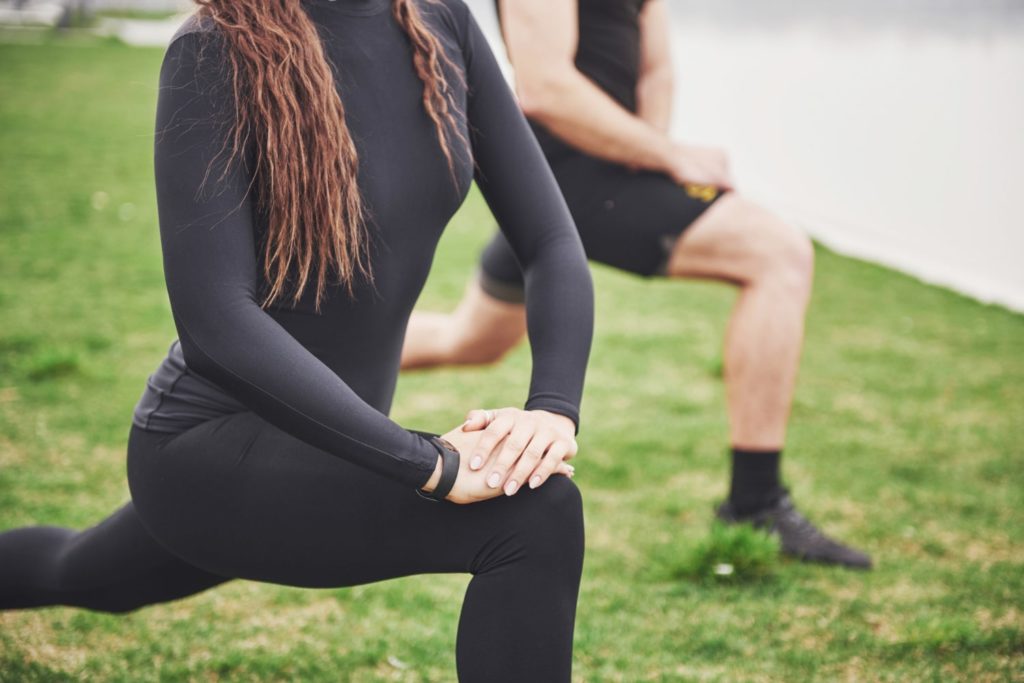
Fitness couple stretching

Stretching, Posture and How to Remain Flexible as We Age (Part 1)

2 minutes to read
Kim Hoffmann

Kim Hoffmann

NASM CES (Corrective Exercise Specialist) and Certified Personal Trainer

Beginner Evidence Based

Jump to:

As a society we have become very sedentary and generally don’t move a whole lot. This lack of movement combined with stress can cause quite a few problems for us, including low back pain or bad posture.

In this article, we are going to focus on a few stretches you can do to alleviate tension and reinforce good posture.

How to stretch

As a general rule, stretches work when there is tension in the muscle. Everybody will have tension in different places or at different intensities.

Hold each stretch for at least 30 seconds

It’s important for your muscles to relax. This takes a bit of time. Once they relax, you can create more stretch by going a bit further. Make sure the stretch is not painful. If it is, you could tense up and the stretch won’t be efficient.

Older people, ages 60 and above, will need to hold a stretch for at least 60 seconds. That’s because muscles get less pliable the older we get, so they need more time before they can relax.

Child's pose

This exercise stretches our back and inner thighs. Start on all fours, spread your knees slightly, and sit back on your heels while bringing hands out in front and your head down towards the floor.

Child Pose - Start
Child Pose - Start
Child Pose - Finish
Child Pose - Finish

If you want to feel the stretch more in your upper back and shoulders, you can put your hands on a chair and push your head and chest down towards the floor.

Forward fold

This is a stretch where we basically try to touch our toes. Start by standing upright with your feet hip width apart. Slowly bend at the hips and try to reach for the floor with your hands. 

Forward Fold
Forward Fold

If you can’t touch the floor, grab your calves or ankles.

Cat cow

This stretch is done on all fours and creates mobility in our spine. Push your chest and bellybutton up to the ceiling to round your back and then slowly bring them down towards the floor to arch it.

Cat Cow - Up
Cat Cow - Up
Cat Cow - Down
Cat Cow - Down

A more advanced version is to focus on each vertebra individually and start the movement in your hips, which requires good control of your pelvis.

Start in the same position but round your back by tilting your pelvis backward. Then slowly work your way up your spine towards your neck, one vertebra at a time. Then go back to your pelvis and tilt it forward, slowly arching your back all the way to your neck.

Standing cat cow

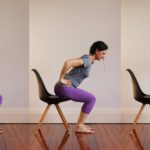
This is similar to the quadruped cat cow except that we do it standing and holding on to a chair. Same as in the previous stretch, we move the lower back in the same fashion.

Standing Cat Cow - Down
Standing Cat Cow - Up

You could use a band to make it more difficult. Bring the band around the feet and your lower back. Make sure there is no or very little slack.

Wall/Doorway stretch

Stand next to a wall or in a doorway. Bring your arm up to 90 degrees with your elbow at about shoulder level. You can adjust the height of your elbow depending on whether you feel the stretch and where you feel it. 

Doorway - Start
Doorway - Start
Doorway - Finish
Doorway - Finish

Bring your forearm and elbow against the wall/doorway and step forward with the same side leg. Twist your body away from the arm that’s on the wall/doorway.

Downward-facing dog

This stretch is for our calves, hamstrings, lower back and upper back. This doesn’t mean you should feel the stretch in every one of those places. I mainly feel this in my calves and lower back. It all depends on where your tension is. 

Start with your feet hip width apart and bring your hands on the floor in front of you. Walk your hands forward so that your body resembles a pike – hips in the air and arms and legs straight. 

Downward Dog
Downward Dog

If you can’t straighten your legs, bring your heels slightly off the floor, but try to push them down so you get that stretch in your calves.

Pigeon pose

For this pose, we need to sit on the floor with one leg stretched out behind us and the other folded in half in front.

Pigeon Pose
Pigeon Pose

Your shin should be in line with the front of your mat if you’re using one. If you’re not very flexible, keep your hands on the floor while you lean your upper body over your front leg. Otherwise try to get your elbows on the floor. Keep your weight centred and try not to lean to one side.

Thoracic spine rotation

There are a few options to stretch the thoracic spine. Bring the elbow of the arm that’s behind your head to the elbow of the arm that’s on the floor. Then rotate that arm up towards the ceiling. Hold, breathe deeply in and out, then bring your elbow back to the other one. Repeat 10 times. 

Important here is that you keep your hips still. It’s very easy to shift them to the side in order to get your elbow further towards the ceilin

Thoracic Spine Rotation - Start
Thoracic Spine Rotation - Finish

If you can’t keep your hips still, another option is to get in a half-kneeling position with the leg up on your foot leaning against a wall. Bring both hands behind your head and rotate your body so your back is against the wall. You can get more stretch by moving your elbow to the wall.

Kim Hoffmann is a certified Personal Trainer and Corrective Exercise Specialist based in Auckland. She also specialises in women’s health and fitness by taking into consideration the menstrual cycle and hormones and implementing them in different workout plans. The workout methods and routines include free weights, suspension straps and boxing, as well as strength training and high intensity…
If you would like to learn more about Kim, see Expert: Kim Hoffman.

Leave a Comment

Your email address will not be published. Required fields are marked *