Acupuncture and neck pain

What Are the Health Benefits of Acupuncture? (Part 1)

3 minutes to read
Margaux Loyer

Margaux Loyer

Diploma in Beauty and Massage Therapy, Certificates in Deep Tissue and Myofascial Release, RYT 200 Yoga Teacher, Bachelor of Health Science in Acupuncture

Beginner Evidence Based

While research continues to uncover acupuncture’s full mechanisms, the evidence strongly supports that acupuncture is an effective integrative therapy for a wide range of physical and emotional concerns. 

By modulating the nervous system, neurotransmitters, the HPA axis, and immune responses, acupuncture 

  • helps reduce pain
  • relieves stress
  • improve sleep
  • balance hormone production
  • enhances overall health

Clinical experience and research suggest that acupuncture is often most effective when received 2–3 times per week, particularly for acute conditions, while chronic issues may require ongoing treatment over time to manage inflammation and pain effectively.

How does acupuncture work?

Acupuncture has been practiced for thousands of years, yet many people still wonder: how does it work and does it actually help?

From a modern biomedical perspective, one of acupuncture’s key effects is helping the body shift out of the “fight-or-flight” state (sympathetic dominance) into “rest-and-repair” (parasympathetic activation), the state where true healing and recovery can take place.[1,2]

When a needle is inserted, it sets off a chain reaction of nerve and chemical signals that help carry and amplify acupuncture’s effects throughout the body.[3]

Sketch map of changes happening during insertion of a needle
Sketch map of changes happening during insertion of a needle.

The needle gently stimulating receptors in the skin, which release neurotransmitters (histamine (HA), serotonin (5-HT), tryptase) that carry signals along nerve pathways to the central nervous system (the brain and spinal cord).

Acupuncture helps ease pain, and it also 

  • supports emotional balance
  • improves sleep and digestion
  • assists hormonal health
  • strengthens the immune system

Because of this regulatory effect on the nervous system, acupuncture has a wide-reaching influence on health.

Pain Relief (Muscular, Joint, and Nerve-Related)

The analgesia (pain killer) effect of acupuncture has been widely explored since the 1970s. 

While we need more research to understand this mechanism fully, there have been studies using brain scans showing that acupuncture can activate areas like the periaqueductal gray and hypothalamus, which are part of the brain involved in reducing pain. 

At the same time, it calms down parts of the brain that are responsible for feeling the intensity of pain.[4]

Acupuncture and pain
A. The percentage of subjects who reported having experienced the given sensation (at least one subject experienced the seven sensations listed). Numbness, fullness, and soreness were found greater for acupuncture at ST36.

B. The intensity of the reported sensations measured by an average score (with standard error bars) on a scale from 0 denoting no sensation to 10 denoting an unbearable sensation.

This mechanism is well documented in neuroscience and supports the longstanding observation that acupuncture has profound analgesic effects.[6,7]

A 14-year study of over 1,000 patients found that acupuncture reduced musculoskeletal pain by an average of 43%

Pain relief was seen across all body regions, ranging from 40% for lumbar pain to 55% for elbow pain. Notably, elbow and shoulder pain showed the greatest improvements, while lumbar pain showed the lowest but still significant benefit.[8]

Clinical studies consistently show the efficacy of acupuncture for conditions such as 

  • osteoarthritis
  • migraine
  • musculoskeletal injuries
  • low back pain
  • neck pain

For example, a meta-analysis including 39 studies and 20,827 patients confirmed that acupuncture produces clinically meaningful pain relief compared with no acupuncture controls.[9,10,11]

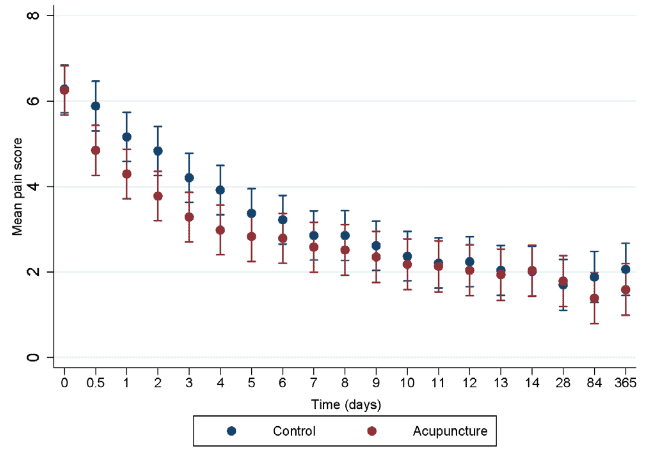
Acupuncture and pain intensity
Pain intensity during a 1-year follow- up period in a trial of acupuncture for acute non-specific low back pain when applied in addition to standard treatment, compared with standard treatment alone (99% CI).

A systematic review of 18 clinical trials with 1,211 patients found that adding electroacupuncture or transcutaneous electrical acupoint stimulation to anesthesia for thyroid surgery improved outcomes. 

Patients had more effective anesthesia, greater cardiovascular stability during surgery, and fewer postoperative side effects compared to anesthesia alone.

These findings suggest acupuncture can enhance the safety and effectiveness of anesthesia, though further high-quality studies are needed to confirm these benefits.[12]

Emotional Regulation: Stress and Anxiety

Acupuncture has been shown to increase the release of serotonin and dopamine, promoting relaxation, emotional balance, and reduced sympathetic overactivity.

A significant part of acupuncture’s regulating effect occurs through its impact on the hypothalamic pituitary adrenal (HPA) axis, and the autonomic nervous system.

Acupuncture increase the release of dopamine

Chronic stress and dysregulation of the HPA axis are known to suppress serotonin synthesis while increasing cortisol levels, leading to hyperactivity of the “flight fight” state. 

Acupuncture has shown to reduce HPA axis hyperactivity, regulating excessive cortisol release and supporting serotonin balance.[13,14]

A randomized controlled trial on 70 women with fibromyalgia investigated the effects of acupuncture compared to sham and placebo controls.

Participants received six sessions over three weeks, and outcomes were assessed through both symptom reports and biological markers. The results showed increasing serotonin levels post-treatments for the acupuncture group.

Acupuncture and serotonin levels
Serum serotonin values at baseline and after completion of all treatments in the three groups.

While the white background represents levels of baseline, the black background represents levels after the treatments in each group.

At the same time, acupuncture enhances vagal tone, shifting the nervous system away from sympathetic overactivation and toward a parasympathetic dominant state, which further facilitates serotonin synthesis and release.[16] 

For instance, a study demonstrated that electroacupuncture (EA) helped regulate stress hormones in animals exposed to chronic cold stress.[17]

Acupuncture and cold stress
Serum levels of stress hormones

(A and B) Effect of EA (Electroacupuncture) given before and concomitantly with chronic cold stress on HPA hormones.

Another study on rats, with chemotherapy-induced fatigue confirm these results:

This neurophysiological shift is why acupuncture is often recommended for stress-related disorders and mental health conditions.[18]

Acupuncture has been shown to modulate serotonin transmission in key regions such as the hippocampus, amygdala, and brainstem, areas directly involved in emotional regulation and cognitive processing.[19] Clinically, these effects contribute to improvements in anxiety, depression, and stress-related disorders.[20]

Evidence from fMRI study shows that acupuncture also influences the emotional centres  of the brain, such as the amygdala and hippocampus, which are linked to stress and anxiety.[21]

Furthermore, acupuncture has shown to have an effect on heart rate variability (HRV), reflecting its ability to regulate the autonomic nervous system and activate vagal tone. 

In a mild hypertension study, participants received a single session of acupuncture. Heart rate variability (HRV) analysis showed that acupuncture decreased the LF/HF ratio (a marker of sympathetic activity) and increased the HF component (a marker of vagal activity).[22]

Acupuncture has a positive effect on heart rate variability

Interestingly, this same study has found that the regulatory effect of acupuncture is more effective on regulating participants who have higher sympathetic drive (stress).

Acupuncture and heart rate variability
Acupuncture and effect on heart rate variability

(A) Changes in the LF/HF ratio and (B) HF power during rest, acupuncture, and recovery. Results are shown as averages with standard error. HF = high frequency; LF = low frequency.

By regulating the nervous system, activating vagal tone, decreasing cortisol level and increasing serotonin availability, acupuncture not only decreases stress levels, alleviates symptoms of depression and anxiety, but also improves sleep patterns. 

Margaux began her career in France, where she trained as a beautician and massage therapist, specialising in helping clients achieve body confidence and wellness goals such as weight loss, beauty enhancement, and relaxation…
 
If you would like to learn more about Margaux, see Expert: Margaux Loyer.

References

(1) Liu, K., Jiang, J. F., & Lu, S. F. (2021). [Effect characteristics and mechanism of acupuncture in autonomic nerve regulation]. Zhen Ci Yan Jiu, 46(4), 335–341. Chinese. doi: 10.13702/j.1000-0607.200665. PMID: 33932001.

(2) Li, T., Litscher, G., Zhou, Y., Song, Y., Shu, Q., Chen, L., Huang, Q., Wang, Y., Tian, H., Teng, R., Wang, H., & Liang, F. (2025). Effects of acupuncture and moxibustion on heart rate variability in chronic fatigue syndrome patients: Regulating the autonomic nervous system in a clinical randomized controlled trial. Complement Ther Med, 92, 103184. doi: 10.1016/j.ctim.2025.103184. PMID: 40315935.

(3) Wu, M. L., Xu, D. S., Bai, W. Z., Cui, J. J., Shu, H. M., He, W., Wang, X. Y., Shi, H., Su, Y. S., Hu, L., Zhu, B., & Jing, X. H. (2015). Local cutaneous nerve terminal and mast cell responses to manual acupuncture at LI4 in rats. Journal of Chemical Neuroanatomy, 68, 14–21. Available from: https://doi.org/10.1016/j.jchemneu.2015.07.003

(4) Bai, L., Tian, J., Zhong, C., Xue, T., You, Y., Liu, Z., Chen, P., Gong, Q., Ai, L., Qin, W., Dai, J., & Liu, Y. (2010). Acupuncture alters neural responses across wide brain networks (fMRI evidence). Molecular Pain, 6, 73. Available from: https://doi.org/10.1186/1744-8069-6-73

(5) Jin, H. O., Zhou, L., Lee, K. Y., Chang, T. M., & Chey, W. Y. (1996). Inhibition of acid secretion by electrical acupuncture is mediated via beta-endorphin and somatostatin. Am J Physiol, 271(3 Pt 1), G524–G530. doi: 10.1152/ajpgi.1996.271.3.G524. PMID: 8843779. https://sci-hub.se/https://doi.org/10.1152/ajpgi.1996.271.3.G524

(6) Cabýoglu, M. T., Ergene, N., & Tan, U. (2006). The mechanism of acupuncture and clinical applications. International Journal of Neuroscience, 116(2), 115–125. 

(7) Zhao, Z.-Q. (2008). Neural mechanisms underlying acupuncture analgesia. Progress in Neurobiology, 85(4), 355–375. 

(8) Fracchia, L., Olivero, A. M., Rustichelli, R., & Pedrali, T. (2024). Acupuncture in musculoskeletal pain: Analysis of changes in pain perception using the NRS (Numeric Rating Scale). Frontiers in Pain Research, 4, 1294428. https://doi.org/10.3389/fpain.2023.1294428

(9) Vickers, A. J., Vertosick, E. A., Lewith, G., MacPherson, H., Foster, N. E., Sherman, K. J., Irnich, D., Witt, C. M., & Linde, K.; Acupuncture Trialists’ Collaboration. (2018). Acupuncture for chronic pain: Update of an individual patient data meta-analysis. J Pain, 19(5), 455–474. doi: 10.1016/j.jpain.2017.11.005. PMID: 29198932; PMCID: PMC5927830. 

(10) Skonnord, T., Skjeie, H., Brekke, M., Grotle, M., Lund, I., & Fetveit, A. (2012). Acupuncture for acute non-specific low back pain: A protocol for a randomised, controlled multicentre intervention study in general practice—the Acuback Study. BMJ Open, 2(3), e001164. doi: 10.1136/bmjopen-2012-001164. PMID: 22734119; PMCID: PMC3383982. https://sci-hub.se/10.1136/bmjopen-2019-034157%5D

(11) Zhang, H., Zhao, M., Wu, Z., Wang, X., Jiang, Y., Liang, J., & Chen, H. (2022). Effects of acupuncture, moxibustion, cupping, and massage on sports injuries: A narrative review. Evid Based Complement Alternat Med, 2022, 9467002. doi: 10.1155/2022/9467002; PMCID: PMC9167071.

(12) Zhang, W., Zhang, M., Han, Y., Liu, Y., Liu, Y., & Sun, C. (2023). Combined acupuncture-medicine anesthesia used in thyroid surgery: A systematic review and meta-analysis. Medicine (Baltimore), 102(1), e32582. https://doi.org/10.1097/MD.0000000000032582

(13) Avena Natural Health. (2025). Adrenal fatigue & HPA axis: Natural remedies. 

(14) Bae, R., Kim, H. K., Lu, B., Ma, J., Xing, J., Kim, H. Y. (2025). Role of hypothalamus in acupuncture’s effects. Brain Sci, 15(1), 72. doi: 10.3390/brainsci15010072; PMCID: PMC11763592.

(15) Karatay, S., Caglar Okur, S., Uzkeser, H., Yildirim, K., & Akcay, F. (2017). Effects of acupuncture treatment on fibromyalgia symptoms, serotonin, and substance P levels: A randomized sham and placebo-controlled clinical trial. Pain Med, 00, 1–14. https://sci-hub.se/10.1093/pm/pnx263

(16) Napadow, V., & Kettner, N. (2014). Neuroanatomic and clinical correspondences: Acupuncture and vagus nerve stimulation. J Altern Complement Med, 20(4), 285–291. 

(17) Eshkevari, L., Permaul, E., & Mulroney, S. E. (2013). Acupuncture blocks cold stress-induced increases in the hypothalamus–pituitary–adrenal axis in the rat. J Endocrinol, 217(1), 95–104. https://doi.org/10.1530/JOE-12-0404

(18) Lv, Z., Liu, R., Su, K., Gu, Y., Fang, L., Fan, Y., Gao, J., Ruan, X., & Feng, X. (2022). Acupuncture ameliorates breast cancer-related fatigue by regulating the gut microbiota-gut-brain axis. Front Endocrinol, 13, 921119. https://doi.org/10.3389/fendo.2022.921119

(19) Lee, E. J., & Warden, S. (2016). The effects of acupuncture on serotonin metabolism. Eur J Integr Med, 8(4), 355–367. 

(20) Tamminga, S. J., Emal, L. M., Boschman, J. S., Levasseur, A., Thota, A., Ruotsalainen, J. H., Schelvis, R. M. C., Nieuwenhuijsen, K., & van der Molen, H. F. (2023). Individual-level interventions for reducing occupational stress in healthcare workers. Cochrane Database Syst Rev, 5, CD002892. https://doi.org/10.1002/14651858.CD002892.pub6

(21) Yang, X., Yang, N. B., Huang, F. F., et al. (2021). Effectiveness of acupuncture on anxiety disorder: A systematic review and meta-analysis of randomised controlled trials. Ann Gen Psychiatry, 20, 9. https://doi.org/10.1186/s12991-021-00327-5

(22) Kimura, K., Kitagawa, Y., & Tajima, F. (2021). Effects of a single session of acupuncture treatment on blood pressure and heart rate variability in patients with mild hypertension. J Altern Complement Med, 27(4), 342–348. https://doi.org/10.1089/acm.2020.0324

(23) Amorim, D., Brito, I., Caseiro, A., Figueiredo, J. P., Pinto, A., Macedo, I., & Machado, J. (2022). Electroacupuncture and acupuncture in the treatment of anxiety: A double blinded randomized parallel clinical trial. Complement Ther Clin Pract, 46, 101541. doi: 10.1016/j.ctcp.2022.101541; PMCID: PMC9760487


Leave a Comment

Your email address will not be published. Required fields are marked *