When we want to retrain our muscles for better posture or to experience less pain, we will need to do both stretching and strengthening exercises. We need the stretching to loosen things up, while strength exercises pull and place our joints in the correct position.
With strengthening exercises we usually work with repetitions. For the dead bugs, for example, I would use 3 sets of 6-10, depending on the difficulty.
For most other exercises I would suggest a higher repetition range (10-15 per set) in order to retrain your muscles. Just for the planks, I would set a timer and do 3 sets of your maximum time. Your maximum time is the longest you can hold a plank for while keeping good form.
Let’s start with deadbugs first.
Deadbugs
Deadbugs is an ab strengthening exercise, and it’s important because it’s the part of our core that we use when lifting. For this exercise lie down on your back with a neutral spine (natural shape with a small gap is okay).
Depending on how strong your core is, you may need to start at different positions. The easiest regression is to start with your knees bent and feet flat on the floor. Slowly straighten one leg while keeping your spine neutral and abs engaged. Bring your foot back next to the other one, then swap.
The next progression would be to bring your legs up to 90 degrees and bring your foot down to the floor while keeping the 90 degree angle.
Deadbug start
Deadbug - Easier Way
Deadbug - Harder Way
One step up from that is to straighten out your leg all the while keeping your abs on and your back neutral. After that you can bring your arms overhead one at a time to make it even more difficult.
Your back shouldn’t round or arch at any point. If that happens, you should have a rest.
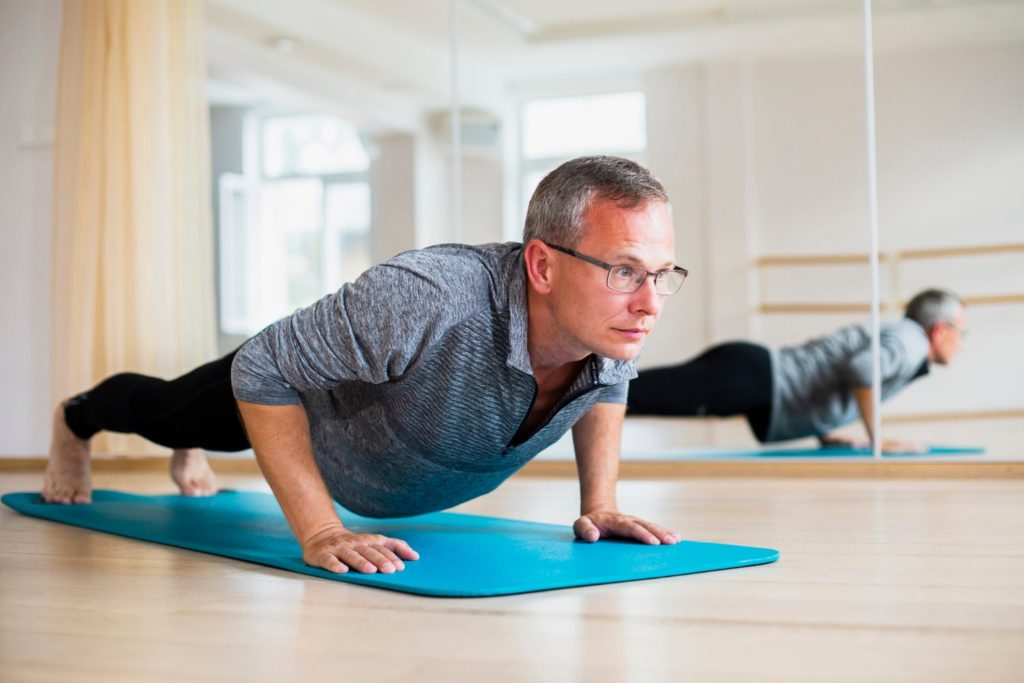
High plank
This is also known as a push-up position. For some this might be a bit more difficult on the arms and shoulders rather than their core. If that’s the case, go in a low plank position, resting on your elbows.
In a high plank position, straighten your legs and arms. Push the balls of your feet into the floor, engage your glutes and core and push the chest up to the ceiling.
High Plank
Low Plank
Hold for as long as you can keep good form. Slowly increase the time.
Side plank
This is a similar position as the previous exercise, but done on one elbow. Your feet should stay stacked one on top of the other and your toes pulled up.
Side Plank
Push your hips and chest up towards the ceiling and try not to lean down to the floor with your top shoulder.
Glute squeezes
The easiest way to do this is to clench your glutes in any position, e.g. seated, lying down, or standing. You simply squeeze your glutes together, hold for a second, then relax and go again.
This may be too easy for some people, in which case I would recommend hip bridges or hip thrusts. For these exercises lie down on the floor (hip bridges) or with your shoulders on the couch/bench (hip thrusts).
Glute Squeezes (do this standing)
Hip/Glute Bridge - Start
Hip/Glute Bridge - Finish
Hip Thrust - Start
Hip Thrust - Finish
Bring your hips to the floor, then squeeze your glutes as you bring your hips up. Do 3 sets of 10-15.
Isometric rows
Ideally for this one you’d use a resistance band. Hook the band behind something sturdy and grab both ends. Step away from the anchor point to create a bit of tension on the band and keep your arms straight.
Bend your arms and bring your elbows to your hips. Hold the position by squeezing your shoulder blades together and down.
Standing row
If you don’t have a band, you can work the same muscles by lying down on the floor face down and bringing your hands next to your body.
Facedown A’s - Start
Facedowns A's - Middle
Facedowns A's - Finish
Squeeze your shoulder blades together and down, then raise your hands off the floor. Make sure you feel this exercise in between your shoulder blades mainly.
Hold for 5-10 seconds, then release and repeat for 5-10 times. Do 3 sets.
Kim Hoffmann is a certified Personal Trainer and Corrective Exercise Specialist based in Auckland. She also specialises in women’s health and fitness by taking into consideration the menstrual cycle and hormones and implementing them in different workout plans. The workout methods and routines include free weights, suspension straps and boxing, as well as strength training and high intensity…
If you would like to learn more about Kim, see Expert: Kim Hoffman.